


Automation surrounds us everywhere. But can you figure out how it works if you're not an engineer and not a technical specialist at all? We boldly answer – yes!
Let's figure out what a PID controller is – one of the most common devices in the field of automation. They are used in ventilation and air conditioning systems, water supply and pressure maintenance systems, microclimate systems and others where precise maintenance of a controlled variable is required.
General definition
PID controller is a device in a control loop with feedback that maintains a given value of the output variable at a certain level by controlling the input influence. It is needed to obtain the required accuracy of the transient process.
Let's break down the definition using an example of a simple process. Imagine we need to fill a container with water to a certain level.
- The device – is us.
- The control loop – is the totality of all means we use to perform the task (tap, hands, eyes, brain).
- Feedback – is our vision, with which we assess the water level in the container.
- The control signal – is a signal from the nervous system from the brain to the hand to open the tap.
The PID controller in this process is the brain. It is the one that processes the information coming from vision and forms the control signal. For this, it needs three components – proportional, integral and derivative.
P – Proportional component
Proportional component – a value proportional to the difference between the setpoint and the current value, i.e., the difference between the fill boundary and the current water level. The greater the difference, the larger the component, the more we open the tap. When the setpoint and current values equalize, we close the tap. The control signal in this case equals zero.
It seems that this is enough, but in practice the controlled variable never stabilizes at the setpoint value. Thus, a steady-state error arises – such a deviation of the controlled variable that provides a control signal stabilizing the output signal precisely at the achieved value.
Imagine that in our case, the container is a wooden barrel with small cracks and holes. The control signal (tap opening degree) gradually decreases as the water level approaches the desired value. But if we completely close the tap, water will start to leak out – this is the steady-state error.
The greater the difference between the current and setpoint values (gain or proportional coefficient), the smaller the steady-state error. However, with too high a gain, considering delays, as well as taking into account the process inertia, self-oscillations may begin in the system, and the system may lose stability.
In our example, this means that with active opening and complete closing of the tap, the water level will strongly deviate from the set level both downward and upward.
I – Integral component
To eliminate the steady-state error, the integral component is used. It is proportional to the time integral of the deviation of the controlled variable.
This component allows accounting for the steady-state error over time. In our example, the brain will independently understand over time how much to open the tap so that the water always stays at the set level.
D – Derivative component
Unfortunately, proportional and integral components work well only in systems where there are no significant external influences (if water in the container almost does not decrease, or decreases at a constant speed). Let's imagine that a tap has appeared at the bottom of our barrel. When it is opened and closed, water flow will change, and the system will lose stability.
To mitigate this effect, the derivative component is used. It increases and decreases together with environmental influences and is intended to counteract deviations from the setpoint that are predicted in the future.
These deviations can be caused both by external disturbances (the added tap in the container) and by delays in the controller's impact on the system. For example, uneven tap opening, as well as the time needed to open it from zero to the required value.
In our case, the brain will notice when and at what speed the water will decrease when the lower tap is opened, as well as the time passing between opening the upper tap and the actual water inflow. The brain will take all these data into account to calculate the degree of water supply (i.e., for calculating the control signal).
Summarizing
A PID controller is the brain of an automated process. In the diagram, we see a graph of the PID controller's operation and its influence on the controlled variable depending on the magnitude of the components.
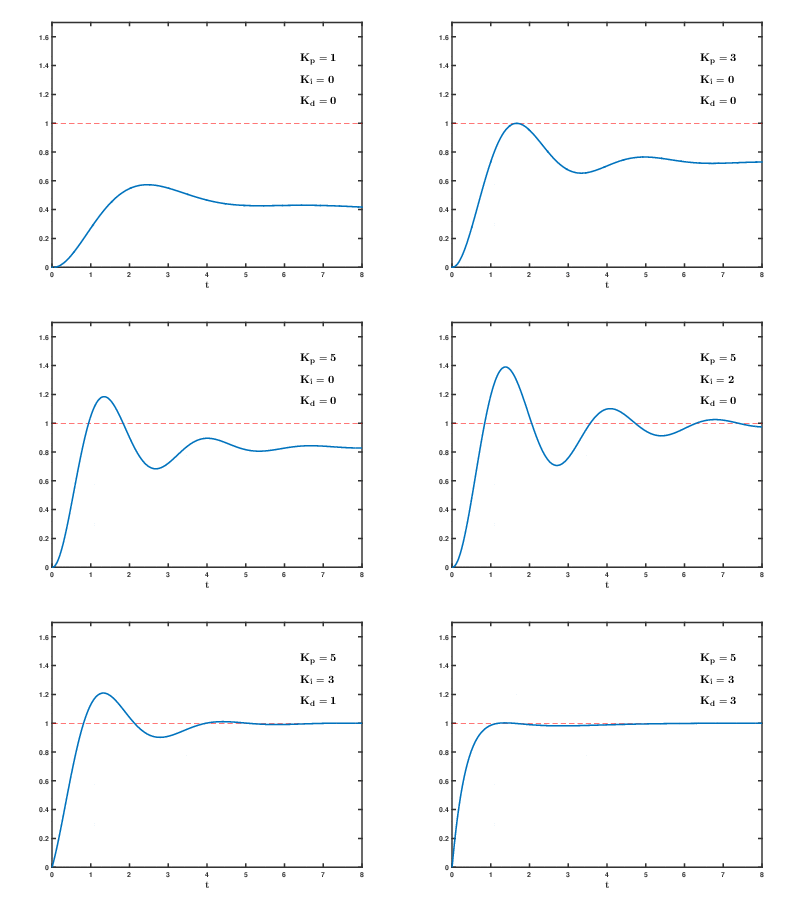
Where Kp is the proportional component
Ki is the integral component
Kd is the derivative component.
PID controllers in modern automation devices
All modern automation tools (programmable logic controllers, programmable relays, ONI frequency converters) have a built-in PID controller. It allows regulating processes with high accuracy.
Modern auto-tuning algorithms simplify the operator's work: specialists only need to set a couple of parameters, and no complex mathematical calculations are needed – mathematical models embedded in the device will do it independently.
ONI frequency converter PID controllers also have a number of additional functions that increase the flexibility and accuracy of the devices:
- sleep mode, allowing significant energy savings,
- availability of several PID controller setpoints that can be switched both manually and automatically.
Still have questions? Ask ONI technical support specialists: support@oni-system.com, tel: