



Have you ever had to connect a house to a main power supply line with SIP (self-supporting insulated wire)? Then you know how difficult it can be to buy everything you need in one place: often one seller may not have the necessary SIP fittings in stock, or there may be too many items in a package, and you'll have to overpay.
For those who want to independently connect their house to a main (street) SIP line, we have released subscriber connection fitting kits for sale. You just need to know: whether you will have a single-phase or three-phase connection. For single-phase, you will need the "ASIP-1" kit, for three-phase — "ASIP-3".
Kit composition
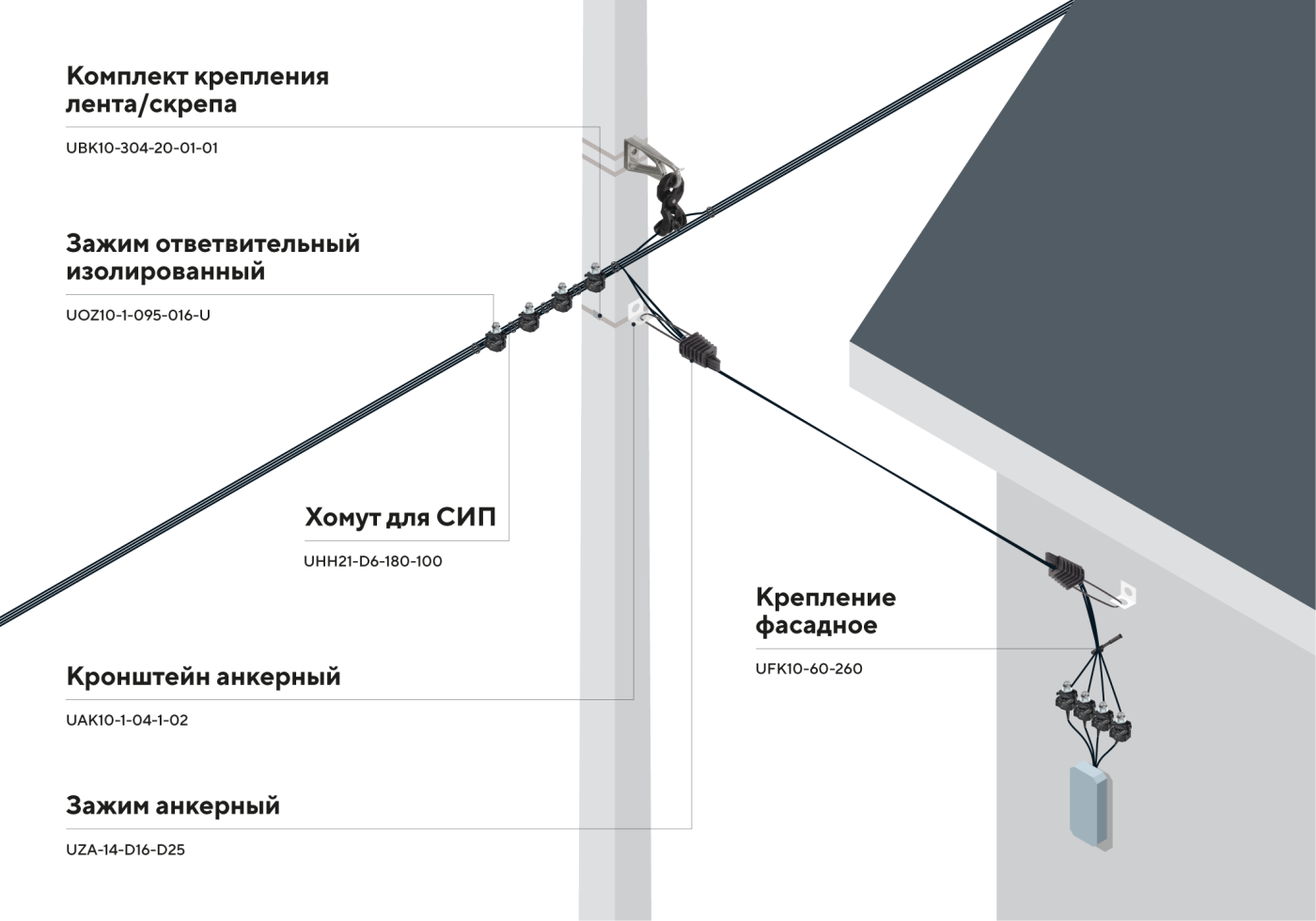
"Tape/clamp KLS-1 201" kit (1 pc.) — for attaching the anchor bracket to a concrete pole. The anchor clamp for SIP is attached to the anchor bracket. The INS-1 tool is used for tensioning and cutting the banding tape.
Anchor bracket CA 16 (2 pcs.) and anchor clamp ZAB
Insulated tapping clamp ZOI 16-95/1.5-16 (4 pcs.) is needed to make two connections to the main line (phase and neutral conductor) and two connections from the consumer side. Note that wires and cables with both aluminum and copper conductors can be connected through these clamps.
Facade mount FK 60 (SF-60) (1 pc.) — a special dowel with a clamp that allows reliable fastening of the SIP wire on the building facade at a distance of 60 mm from the wall. This is required by fire safety regulations: it is not allowed to fasten SIP wire to a wall in any other way.
SIP clamp KhS-180 (3 pcs.) — for fixing wires at the connection point to the main SIP line, to ensure reliable and aesthetic installation.
All elements form a single system for connecting the house to the power grid. Schematically, it looks like this:
Mounting tips
Line assembly should start "from the end": with the connection of the consumer's input switching device. Lastly, the subscriber's SIP is connected to the main line. This makes the installation process safe. At the same time, de-energizing the line is not required.
We remind you that it is strictly forbidden to bring SIP inside a building. In case the input switching device is installed inside the premises, a transition to a copper conductor with appropriate insulation is needed.
Before connecting the SIP to the input device, its core must be crimped with special lugs.
It is useful to know the rules of SIP color marking, which differ from the usual cable core marking.