


After the announcement of the new ARMAT IEK modular equipment line, you often asked: "When will an electromechanical RCCB appear in this series?"
It's already in the assortment! In this article, we will talk about the new product and compare it with other IEK ARMAT line RCCBs.

RCCB ARMAT B10N — a wealth of possibilities in a compact housing.
Application area of RCCB
Residual-current circuit breaker is an important device that should be in every electrical panel. It protects a person from electric shock, and the electrical network — from overload and short circuits. RCCB is used not only in residential buildings but also in the most critical areas — in social and commercial facilities, industrial enterprises.

Distinctive feature of RCCB B10N ARMAT
One of the main distinctive features of the electromechanical RCCB B10N ARMAT is independence from voltage between poles. The device will operate in any case:
— in the presence of a differential current (difference in currents in the poles) of sufficient magnitude
— in the presence of an overload current or short circuit current in any of the poles.
"What's so special about that?" — you might ask. Indeed, all RCCBs have such protection. The difference of the ARMAT B10N RCCB is that with a width of 2 modules, it has full protection against overload and short circuit not only in the phase pole but also in the neutral pole.
Breaking capacity
ARMAT B10N RCCBs have a high breaking capacity — 10 kA. This guarantees safe and reliable operation of the device at high short-circuit currents.
Such a high value is ensured by the B10N design:
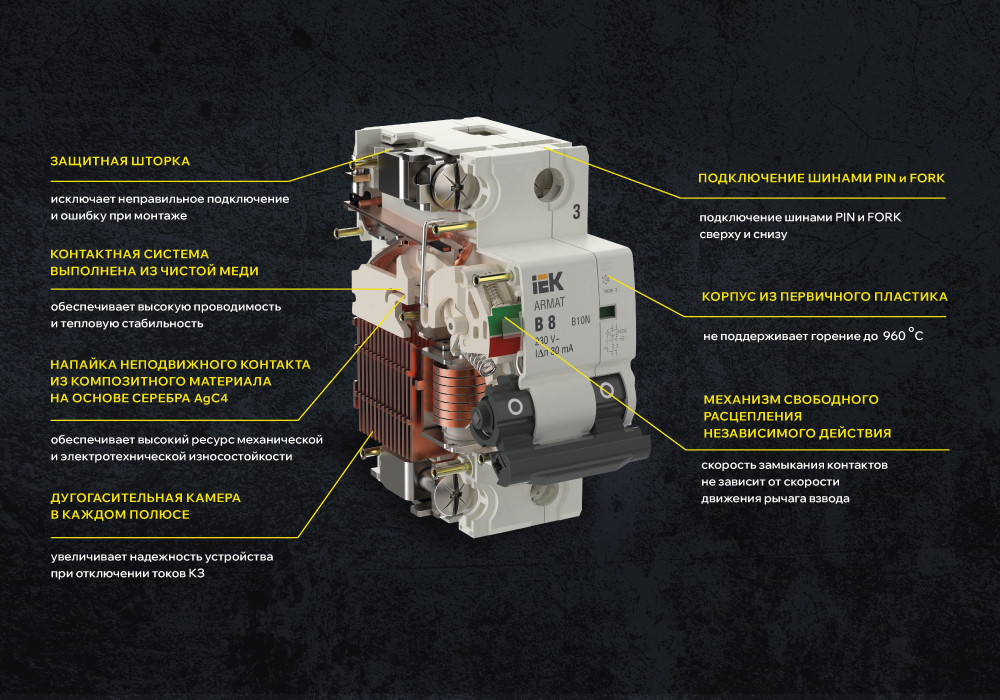
- Moving and fixed contacts are made of pure copper, which means minimal contact resistance and thermal stability.
- Contact tips made of carbon silver AgC4 guarantee low resistance and resistance to high temperatures during arcing. That is, the contacts practically do not burn even with multiple switching at overcurrents. As a result — high switching endurance (10,000 on-off cycles at rated current).
- Each pole has its own effective arc chute containing 14 copper-plated plates. The special design of the arc chute grid, arc-diverting magnets, protective anti-welding screens — all this also allows dissipating the destructive energy of the electric arc quickly and without consequences.
- For contact separation, a free-release mechanism of independent action is used. The contacts will open instantly in any case, both during automatic and manual switching off. This significantly affects arc formation and extinction.
Construction of RCCB B10N ARMAT
It's better to see once than to read about it :)
And a few more advantages of RCCB B10N ARMAT
- Screw terminals have protective shutters that prevent incorrect wire installation.
- PIN and FORK busbars can be connected both from the top and bottom.
- ARMAT B10N RCCBs are completely symmetrical — power can also be supplied from both top and bottom, and swapping phase with neutral wire will not affect operation.
- Up to four additional devices can be attached to the B10N ARMAT RCCB, as well as to all devices of the IEK ARMAT line.
- The rated tightening torque is 2.5 N·m. If necessary, the torque can be increased to a maximum of 5 N·m. This was achieved thanks to eight brass rivets, a primary plastic housing, and powerful screw terminals.
Comparison of IEK differential protection devices
For your convenience, we provide a comparative table of IEK differential protection devices.
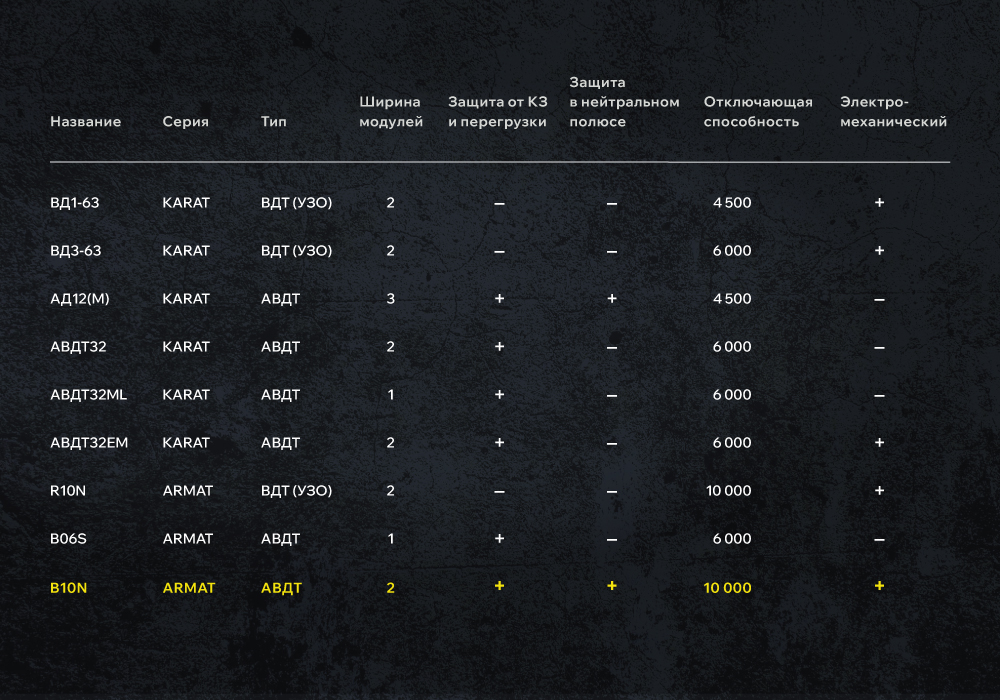
Comparative table of IEK differential protection devices.
All models have their own features. For example, electronic B06S ARMAT RCCBs are compact and occupy only one module on a DIN rail. However, the new B10N clearly surpasses other devices in all aspects.
Of course, this does not mean that you need to abandon other RCCBs in favor of B10N. Choose the RCCB that suits you based on your task and budget!