


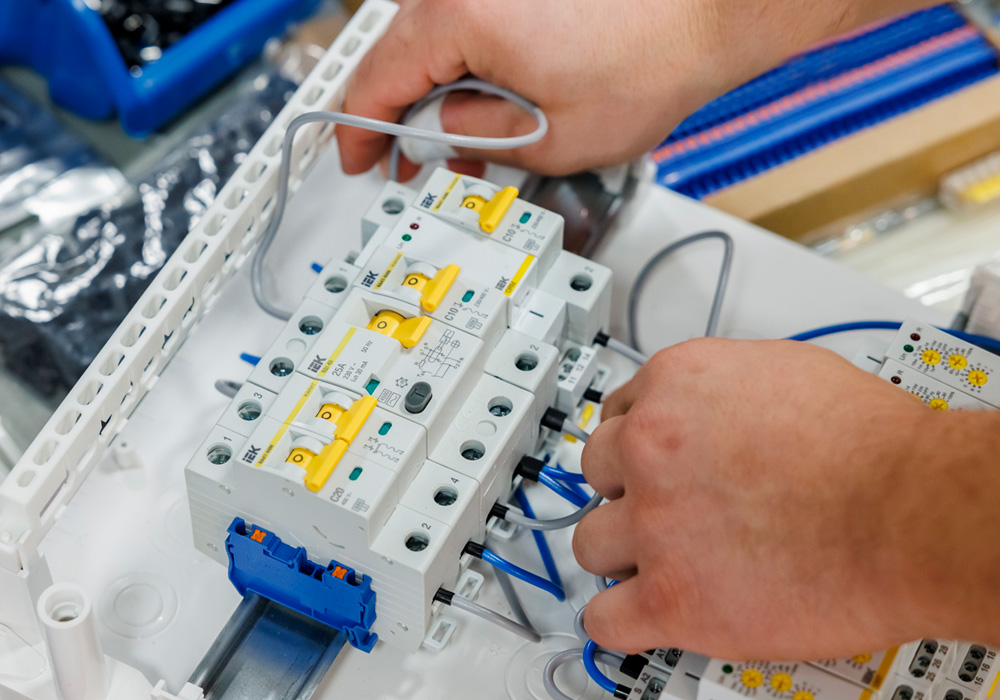
Many of our readers know how this or that device works individually. But when assembling an electrical panel, questions often arise: how to choose protective devices, how should they interact with each other and the load, in which regulatory documents is this mentioned? It is not always easy to find information on how to assemble an electrical panel from scratch, taking into account all the subtleties of selecting elements in combination.
In this article, we will discuss the nuances of assembling a basic electrical panel circuit with reference to real loads.
Initial data
Need to assemble a budget electrical panel for a one-story cottage with an area of 100 m2 with gas heating. The house has a three-phase supply, allocated power is 15 kW, the main circuit breaker for 32 A and the electricity meter are located on a pole.
Where to start?
Of course, with the technical assignment. Based on it, we will think through the overall assembly strategy, the circuit, and the correct operation of the protections. We have a floor plan with the location of sockets, lighting fixtures, and the electrical panel. We also know the equipment power and the location of household appliances.
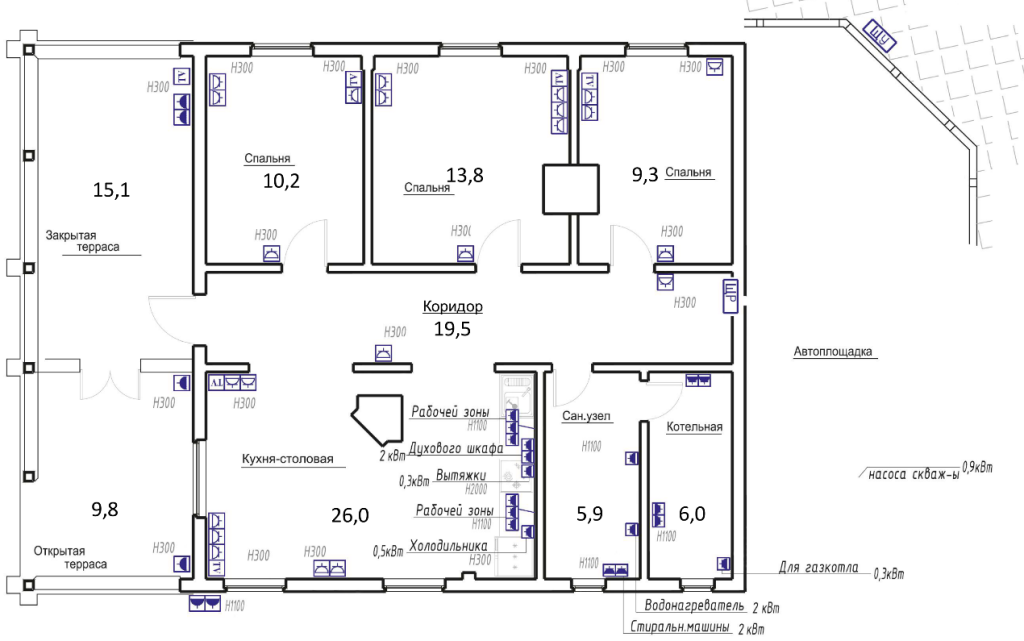
Layout of sockets and switches in the room.
Task: select cables and protective equipment for a basic level panel.
Distribution into groups
What guidelines do we use?
SP 256.1325800.2016 "Electrical installations of residential and public buildings. Design and installation rules."
SP 256, clause 10.2 (distribution of loads into groups).
SP 256, clauses 15.28, 15.28 (norms for the number of sockets).
Let's designate the number of socket groups. As a rule, wiring accessories are grouped in relation to the room and the equipment located in it.
On our plan, we will delineate the socket groups, they are highlighted in different colors (see Figure 2).
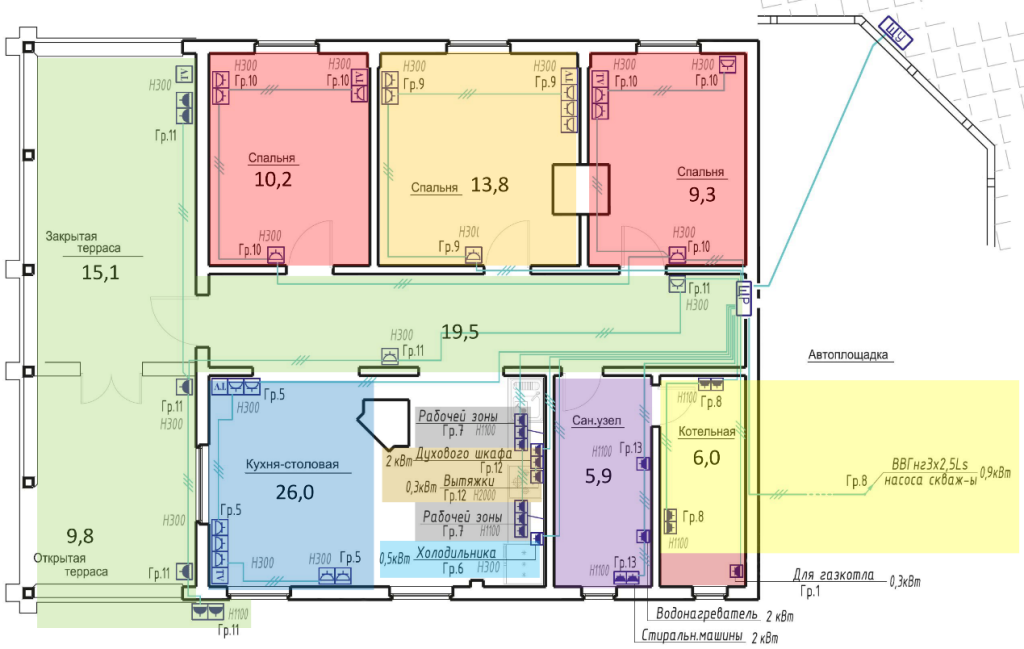
Socket groups.
We will combine non-residential premises into one socket group: open and closed terraces and corridor (green color on the diagram). We will also assign two small bedrooms to one group (red color), and bring a separate group to the large bedroom (orange color).
The kitchen-dining room will also have its own line (blue color). We will divide the kitchen into several socket groups: work area (gray color), refrigerator (light blue color) and oven with hood (beige color).
For the bathroom, we also provide a separate group (highlighted in purple), for the boiler room – a line for the boiler (yellow color) and a line for sockets and the pump.
In total, there are 11 socket groups in the cottage.
Combining lighting groups
Our recommendations:
- Provide at least two lighting groups.
- Power supply for lighting fixtures should be separate from socket groups.
- For each room, two types of lighting should be provided: general (ceiling lights) and local (wall, table, etc.).
In our case, we have identified 3 lighting groups (see Figure 3). We will combine lines for ceiling lights in non-residential areas into one group (highlighted in red on the plan). Another line will be for wall lights in living areas and corridor (green color). Another group – for ceiling lights in living areas (yellow color on the plan).
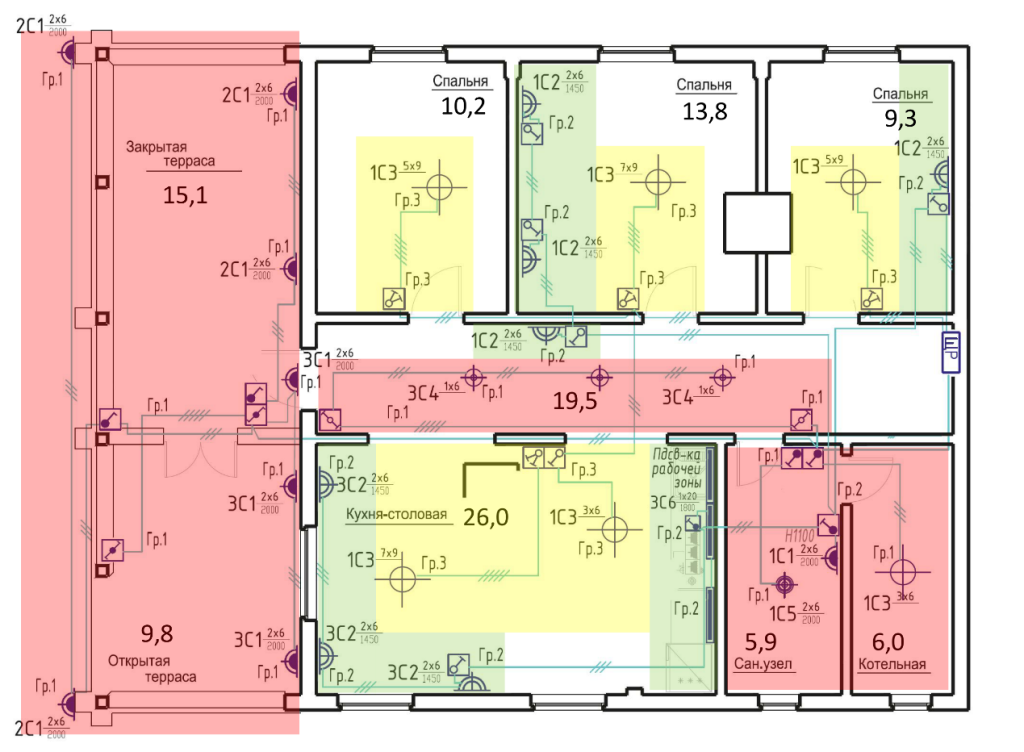
Lighting groups.
Load calculation
What guidelines do we use?
SP 256, Chapter 7.
Let's calculate the value of consumed power. Simply adding up the nameplate power of consumers is not possible: this way we will get an overestimated current value and extra costs.
Calculations can be made using formulas, based on the hourly maximum of consumed power using demand and utilization factors. We will use a table developed by IEK GROUP technical training specialists:
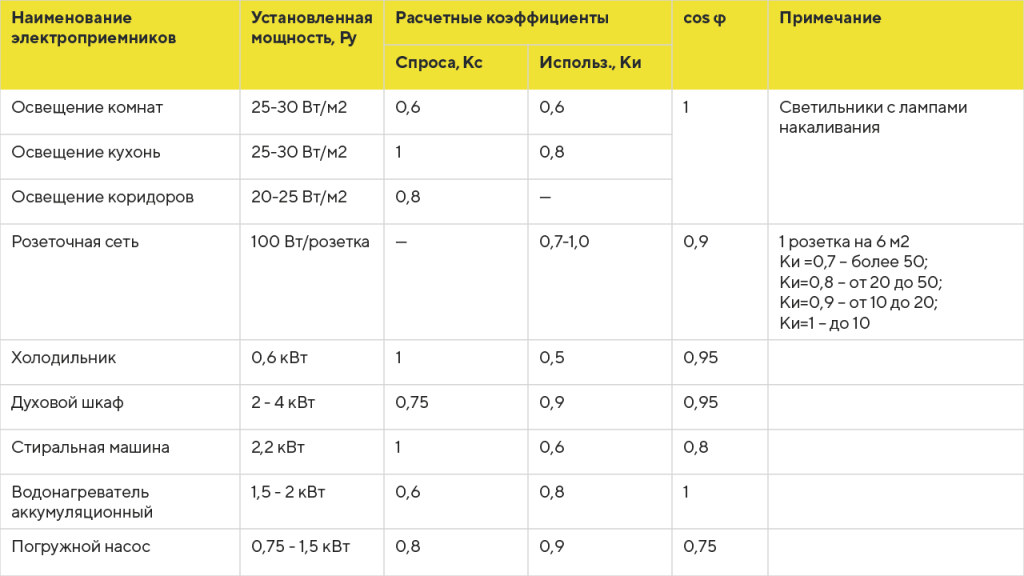
The power factor (cos φ) must also be taken into account. Usually this characteristic is indicated in the passport. For active loads, for example, an oven, cos φ is 0.95, and for consumers with motors, for example, a pump, it is 0.75. Therefore, if the same power is indicated in the passports, the consumed current may differ.
For simplicity of calculation, you can take cos φ = 0.9.
We recommend entering the results into a summary table for competent design of the electrical panel diagram. Below is an example of such a table with a breakdown by groups. Some information is still hidden.
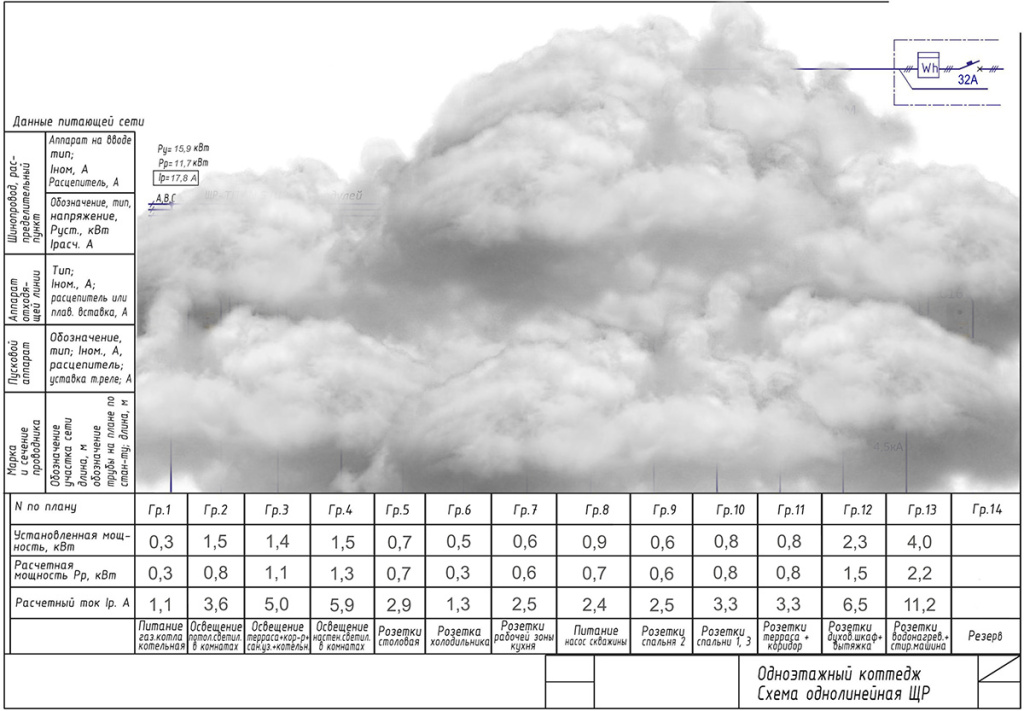
Power consumption of equipment in the cottage.
We determine the total calculated power, it should not exceed the allocated power. Based on this, we select equipment. We can also calculate the total current. When further selecting the main circuit breaker, it must be taken into account that its rating must not be lower than the total current.
These values have already been entered into the table above.
Cable selection
What guidelines do we use?
GOST
GOST R
SP 256, Table 15.3 (cable cross-section selection).
When selecting a cable, the value of the continuous permissible current, which depends on a number of external conditions, is primarily important:
- Method of installation (open, in walls, trays, ducts, etc.).
- Presence of adjacent power circuits running nearby.
- Ambient temperature.
- Presence of current distortions by the load.
- Load operating modes and starting current values.
Another important criterion is fire safety. For most groups, we choose VVGng(A) LS cable. The LS index means that when burning, the cable emits a minimum amount of smoke, so in residential premises it is necessary to use it.
For socket groups, we choose a copper cable with a cross-section of 3×2.5 mm2, for lighting circuits – with a cross-section of 3×1.5 mm2.
According to manufacturer data and GOST R
We will connect the submersible pump with a cable with rubber insulation, type KG 3×1.5 mm2. From the outdoor pole to the electrical panel, the main cable VVGng(A) LS 4×10 in a HDPE pipe will be laid.
We enter the selected cables into the table.
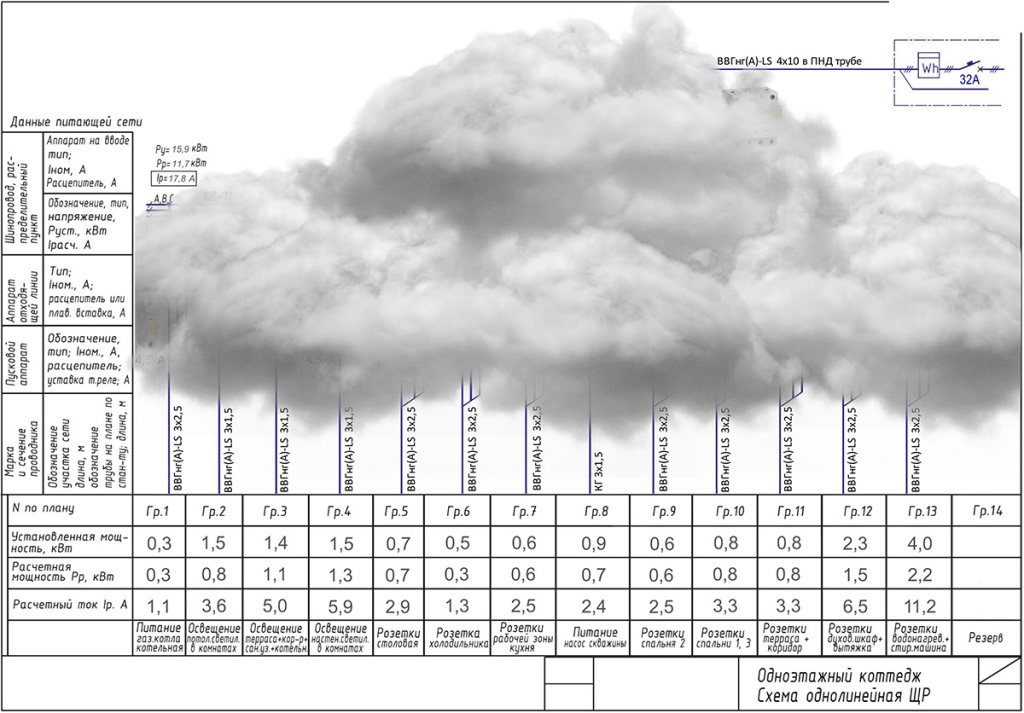
Cable selection for organizing electrical wiring.
Selection of protection devices
The main rule for selecting circuit breakers – the rated current of the CB must be greater than the calculated load current, but less than the continuous permissible current of the cable.
In other words, the circuit breaker should not trip during normal operation of electrical appliances. At the same time, it should trip in case of an emergency current excess to prevent cable overheating.
We select circuit breakers taking into account the time-current characteristic (TCC). For most household loads, circuit breakers with TCC B and C are suitable. For LED lighting, we recommend installing TCC C, and for loads with high starting currents – D.
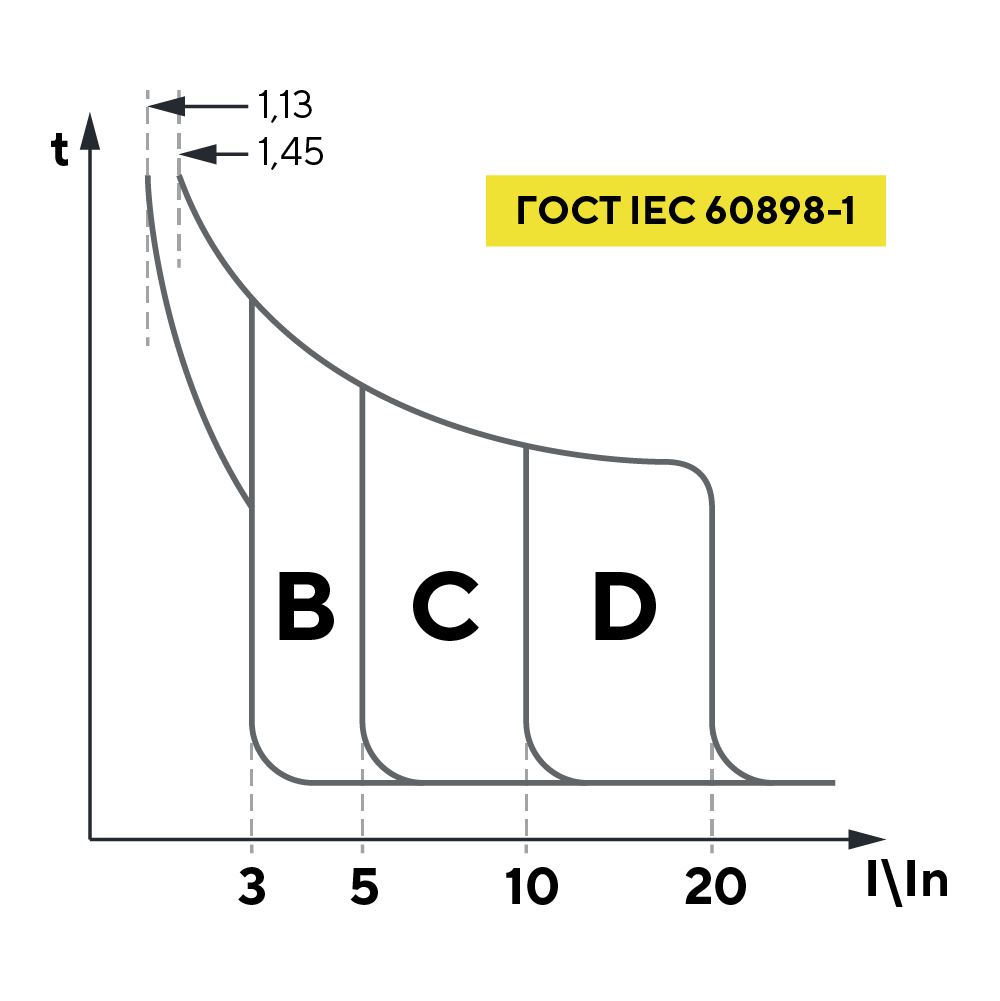
Selection of circuit breakers depending on the time-current characteristic.
Selection of circuit breakers based on breaking capacity
What guidelines do we use?
GOST
We choose a circuit breaker with a breaking capacity of 6 kA for the input, and circuit breakers for outgoing lines will be chosen at 4.5 kA.
KARAT series circuit breakers VA47-29 and VA47-60M are suitable for us.
At this stage, our diagram takes on the following outlines:
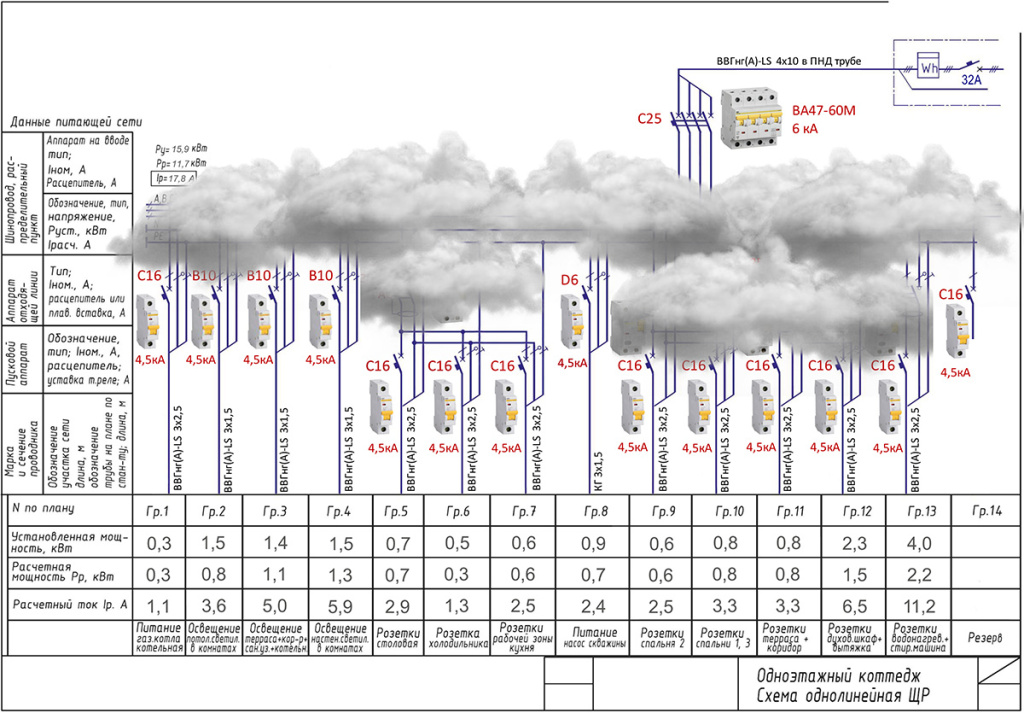
Selection of circuit breakers.
Selection of residual current devices (RCDs)
What guidelines do we use?
SP 256: Appendix A, as well as clauses 10.2 and 10.13.
In all socket groups, residual current devices with a setting of 30 mA should be used. Also, SP 256 (clause A.4.15) requires installing RCDs with a setting of 10 mA on a dedicated line in showers, bathrooms or sanitary cabins.
It is necessary to take into account the conditional short-circuit current – the characteristic must be not less than the rated maximum breaking capacity of the circuit breaker installed in series. Also, the rated current of the RCD must be not less than the rated current of the circuit breaker.
Taking into account the selection of RCDs, the diagram looks like this:
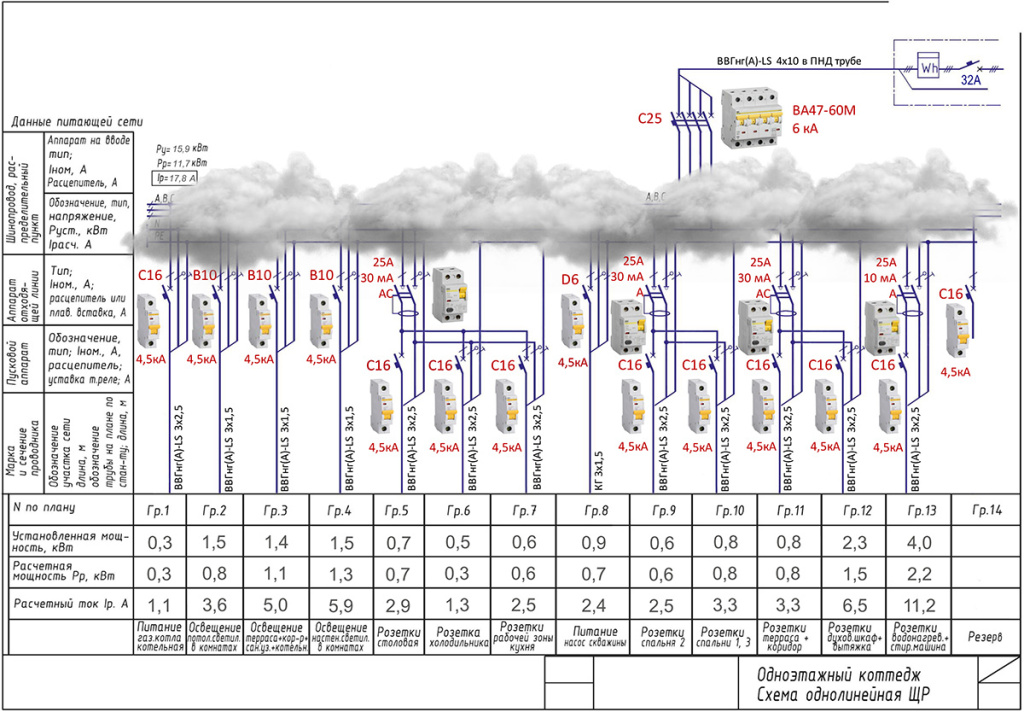
Selection of residual current devices (RCDs).
We use KARAT series RCDs.
Load distribution
What guidelines do we use?
SP 256, clause 10.5.
When distributing loads across phases, the difference in currents of the most and least loaded phases should not exceed 30% within one electrical panel and 15% at the beginning of supply lines.
By simple summation of the calculated load currents per phase, we selected the optimal distribution:
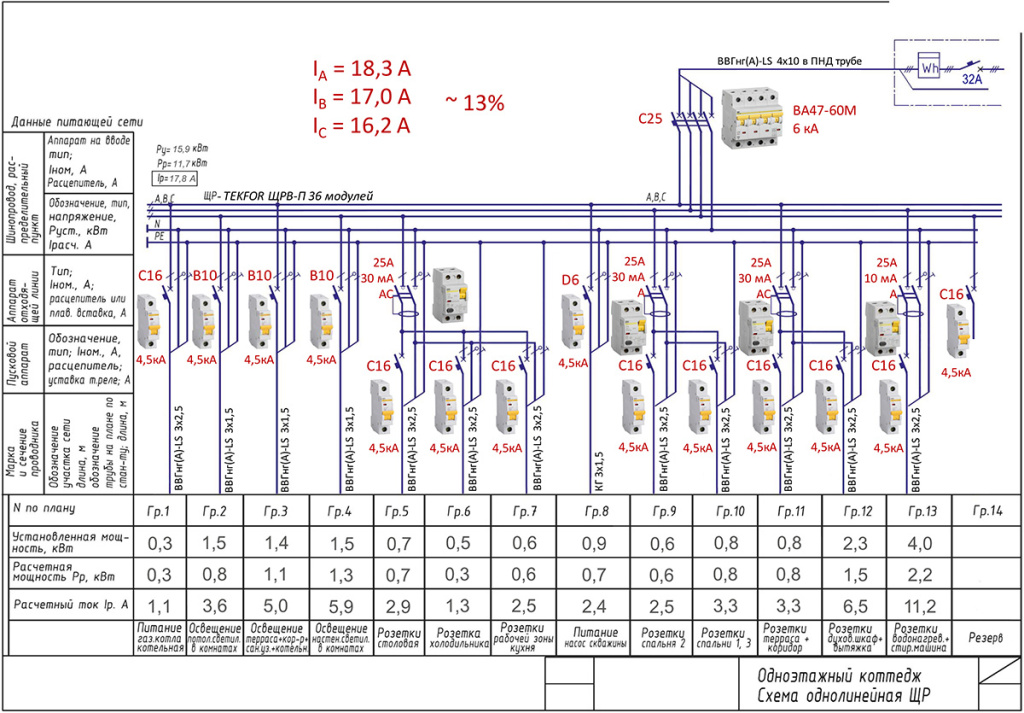
Load distribution.
Phase A powers the gas boiler, lighting of the terrace, corridor, bathroom and boiler room, as well as the pump. In addition, phase A goes to the sockets of the terrace and corridor and to the sockets of the oven and hood.
Phase B goes to two socket groups in the bedroom, the water heater and the washing machine.
Phase C powers wall and ceiling lighting in the rooms, dining room sockets, kitchen work area and refrigerator.
Housing selection
We need a housing that will accommodate equipment for 26 modules. We recommend leaving space "in reserve" of
It is not worth saving on panel dimensions. First, free space facilitates air circulation. Secondly, you may later want to add other elements – voltage relays, contactors, spare groups.
Assembly
We connect switching devices using connecting busbars. We will also need a cross-module for distributing neutral conductors.
The neutral conductor goes from the main circuit breaker to the common busbar in the cross-module. Then the neutral goes from the common busbar to the residual current device. After the RCD, the neutral goes to separate busbars in the cross-module, the neutral conductors of consumers protected by the RCD will be connected to them.
For more details on assembling a basic level panel, see the video: